Semaphores
Why the name?
The word semaphore in Greek means "sign-bearer" or "signal-bearer." Also, in Italian semaphoro means traffic signal. It was used in the past to send signals between two locations using flags or lights between ships or between towers.
In case of threads, the semaphore is used to exchange information between threads. But it's not directly between the threads.
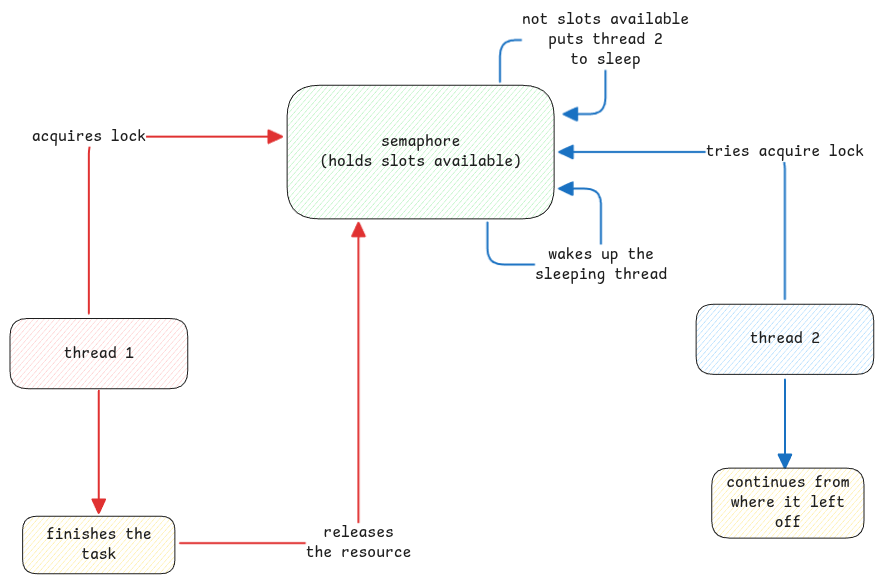
One thread which wants to acquire a resource which is protected via semaphore, will be put to sleep if there is no resource available.
The other thread then informs the semaphore when its frees the resource, and the semaphore then wakes up one of the waiting threads.
- Mutex - it's a lock which can be used by only one thread at a time.
- Semaphore - it's a lock which can be used by multiple threads at a time. It has a counter to keep track of the number of threads that can acquire the lock at a time.
- Blocking queue - it's a data structure which can be used to exchange data between threads. It's mainly used to hold data and how the producers and consumers exchange data between them using the queue.
Kernel Level Semaphores
Kernel also has its own semaphores which are used to synchronize access to kernel resources.
Some of the example use cases of kernel level semaphores are:
- If two processes wants to access a shared memory location, then application level semaphore isn't enough.
- If multiple device drivers try to access hardware registers.