Raster
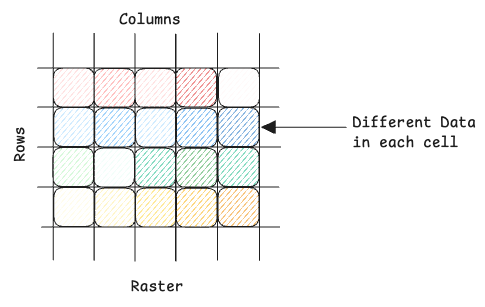
Raster means a matrix of cells where every cell holds data or information. Whereas, a grid is just geometric framework of lines.
This is used mainly to represent images. Digital images such as JPEG stores the color of each pixel in a raster/grid format.
Raster comes from the same origin as German word Radier in Radiergummi. It means scraper.
In the past, wax was applied on a glass sheet and then the wax was scrapped using a rake like tool. This created the raster pattern on the wax. Depending on the thickness of the wax that was scrapped, the grid allowed different levels of light to pass through it.
This was how colors of different brightness levels were produced.
Raster vs Vector Images
-
Raster Images - They're regular images which stores what color must come at each pixel of the image.
-
Vector Images - They store mathematical instructions for the graphics engine to draw the image. The renderer has to execute this and create the image at runtime. This is how SVG images work.
The displays we use have only pixels. Therefore, vector images must also be converted to raster images before they can be displayed.
Chrome for example uses libraries to perform this conversion. These libraries use GPUs when available to rasterize and display them.
For raster images, zooming in will show the pixels and the image will look blurry. Because the information in the cells is same. Whereas for vector images, zooming in won't make the image blurry. Because the renderer will re-execute the instructions and draw the image at a higher resolution.