Continuous Batching
It's an implementation detail of the inference engine achieve the following goals.
- Process concurrent requests.
- Ensure GPU resources are fully utilized.
This is the most important mental model to understand.
It depends on the mathematical operation to be performed.
- For attention operation, the kernel parallelizes the compute for each request.
- For other operations, the length is already same across all requests. The requests are put into one single matrix where token of every request is one row in the matrix. All operations are performed on this one single matrix. Matrix multiplication by its nature allows to extract output of each request from the result matrix.
The full implementation is shared between inference engine and the GPU kernels. The inference engine batches the requests and sends it to the GPU kernel.
GPU Kernel's features such as paged attention, variable length requests enhances the batching.
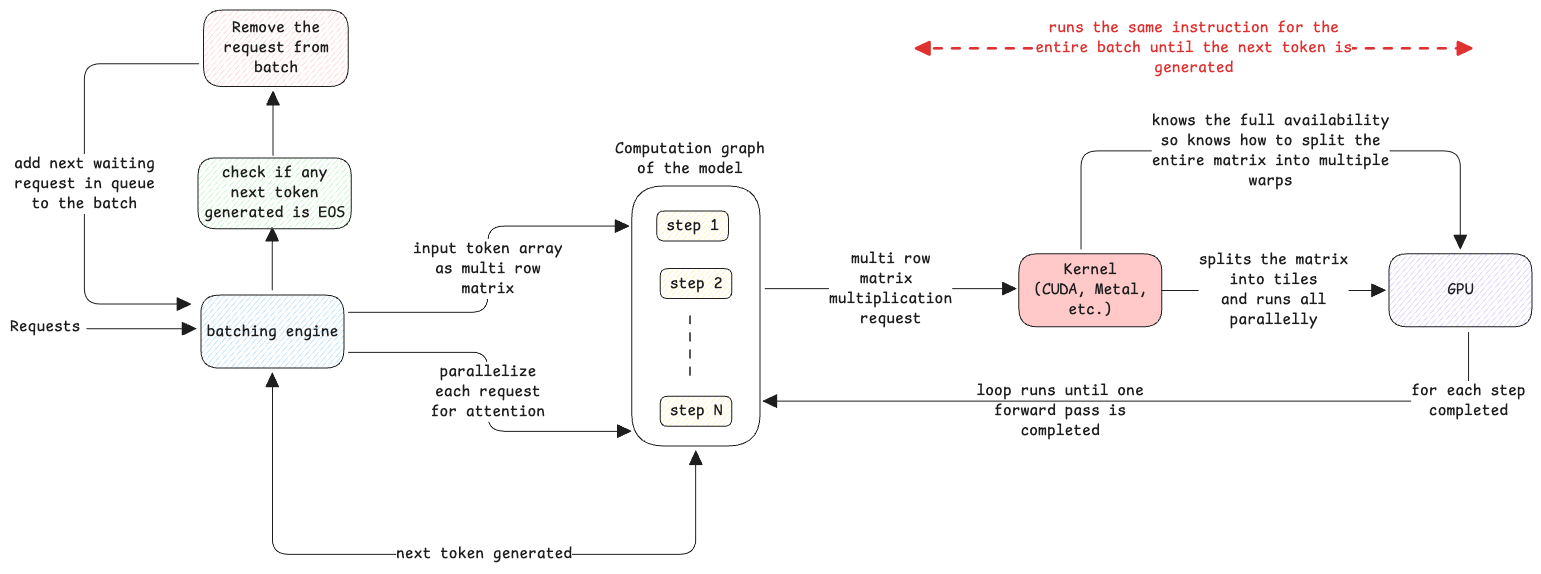
Warp already ensures all threads in a warp execute the same instruction but for different data.
Where as in continuous batching, Kernel sends the same instruction across Warps to utilize GPU completely.
Continuous Batching only with in a model
The continuous batching is applied only for requests of the same model. This is a prerequisite for the following reasons.
- The request is batched for the entire forward pass. This is possible only when all requests follow the same computational graph.
- This ensures the same instructions are executed for the entire batch.
Weights of the model are already fully loaded in GPU memory.
Batching prefill and decode requests
Requests for the inference engine can be of type decode or prefill. The continuous batching handles both. Both requests are put in the same batch and processed together.
Chunked Prefill
We put both prefill and decode requests in a batch. but prefill requests always take more time. This delays the entire batch.
Chunked prefill solves this exact problem. The prefill requests are split into chunks of a certain configured size. This ensures the decode requests inside a batch aren't blocked waiting for a prefill to be completed.
Paged Attention
Paged Attention indirectly benefits continuous batching. In case of continuous batching, each request in the batch uses its respective pages of the KV cache.
Also, we don't need any padding as well since every request is handled separately.
Note the calling function paged_attention_kernel<<<grid, block>>> in the example below.
This is nothing but a parallel for loop.
It tells CUDA to execute this block of code for each grid value.
__global__ void paged_attention_kernel(
    float* output, float* query, float* key_cache, float* value_cache,
    int* block_tables, int* seq_lengths)
{
    int seq_id  = blockIdx.x;   // which sequence this block handles
    int head_id = blockIdx.y;   // which attention head this block handles

    int my_seq_len = seq_lengths[seq_id];       // e.g. 40 for seq 3, 300 for seq 4
    int num_blocks_for_this_seq = (my_seq_len + BLOCK_SIZE - 1) / BLOCK_SIZE;

    for (int b = 0; b < num_blocks_for_this_seq; b++) {
        int physical_block_id = block_tables[seq_id * MAX_BLOCKS + b];
        // ... read key_cache/value_cache at physical_block_id,
        // ... accumulate attention score for this (seq_id, head_id) ...
    }

    // write result for (seq_id, head_id) to output
}
// Execution configuration: one block per (sequence, head) pair
dim3 grid(num_sequences, num_heads);   // e.g. (4, 32) = 128 blocks total
dim3 block(threads_per_block);          // e.g. 128 threads per block

paged_attention_kernel<<<grid, block>>>( // Parallelism is defined here in triple brackets.
    output,
    query,
    key_cache,      // physical block storage, NOT one array per sequence
    value_cache,
    block_tables,   // block_tables[seq_id] = list of physical block indices
    seq_lengths      // seq_lengths[seq_id] = 40, 250, etc.
);