Number Series
It helps to know how to read different number series and find their sums. This matters in general, and for big O calculations.
Keep in mind that the value at each position comes from the previous ones. This is why the sum is often shown using just the last elements.
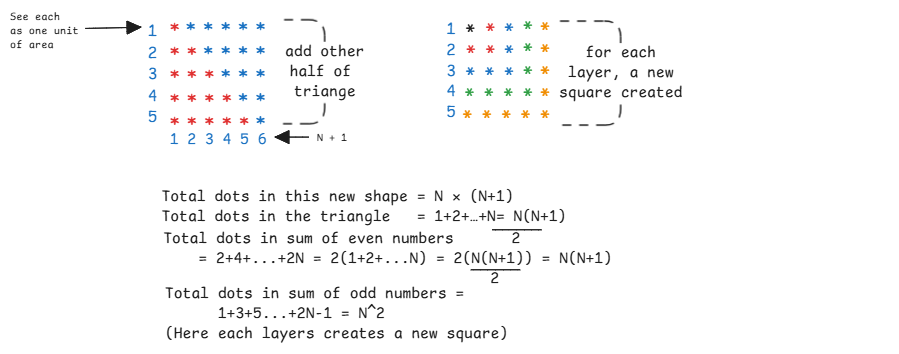
In all the sum series, the goal is to find the area from the series. The sum is the total area from each position.
Here N isn't the value at the position. N is the position itself. Use this for all N's in the table below.
For example, in the sum of odd numbers, the N in is the last position.
| Number series / pattern | Formula / closed form | Why it appears in interviews |
|---|---|---|
| Arithmetic series | Iteratively adding a constant to each position. | |
| Sum of first N numbers | Counting loop iterations, triangular loops. Same as above. But adding 1 to each position. | |
| Sum of 1 through N−1 | Pair comparisons, nested loops. Same rectangle mental model. Just one layer less. | |
| Sum of odd numbers | Explains quadratic growth. Here 2N-1 is the value at each position. Eg., 2×1-1, 2×2-1. | |
| Sum of even numbers | Loops skipping by 2. Here 2N is the value at each position. Eg., 2×1, 2×2. | |
| Sum of powers of two | Trees, recursion trees, BFS/DFS | |
| Geometric series | Divide-and-conquer analysis | |
| Harmonic series | Amortized analysis (hashing, resizing) | |
| Average of 1 to N | ≈ | Expected value, amortized cost. Here we take sum of first value and the last value and take its average. |
| Powers of two | Binary structures, divide-and-conquer | |
| Number of pairs | Comparing all pairs. This is just the regular combinations formula. | |
| Number of subsets | Power set, bitmask problems | |
| Number of permutations | Backtracking, ordering problems |
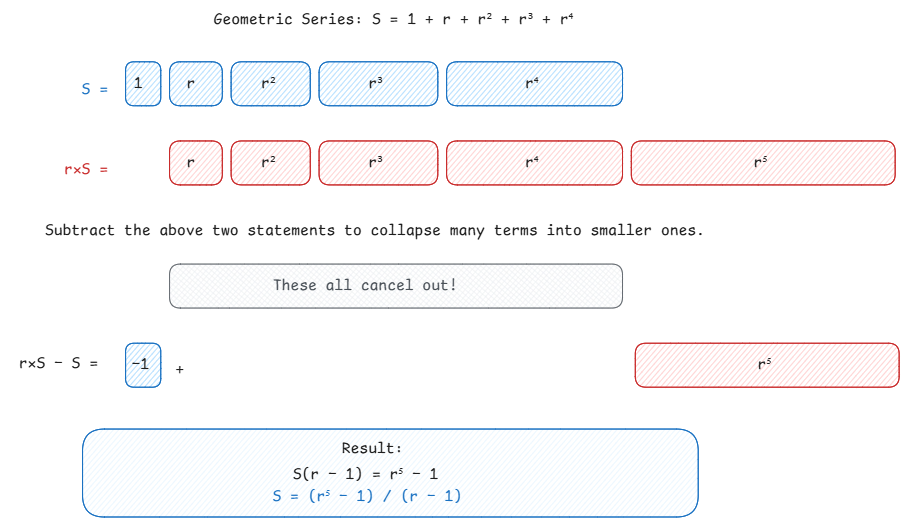
In a geometric series, each element is multiplied by a constant. The shape and proportions stay the same.
In an arithmetic series, a constant is only added to each element.
- power set - Explained in detail in the combinatorics doc.
- Harmonic series - The name comes from music. Different string lengths make different sounds.
- Bit mask - Explained in detail in the algorithms learnings.
- Number of pairs - This is also used for same use cases where there are nested for loops. Similar to Sum of 1 through N−1.
Mental models for remembering formulae
The list of formulas above is long. We need mental models that stick forever.
Using geometry as the mental model will help us to remember the number series formulae.
Arithmetic Series
Geometric Series
Here each position is proportional to the previous one. The base of the exponent is the variable. The size at each step depends on both the base and the exponent.
It looks confusing. We mostly use to get the sum of all numbers up to . This is because each term is multiplied by . The next term is much bigger than the last.
Another way to see it: each next term already holds all the parts of the previous series.