Complement
Complement in English means, something that completes or goes well with something else. The same meaning holds here as well.
It's a concept in mathematics that can be applied to any number system. 2's complement is most widely needed, as computers use addition circuits to perform subtraction as well.
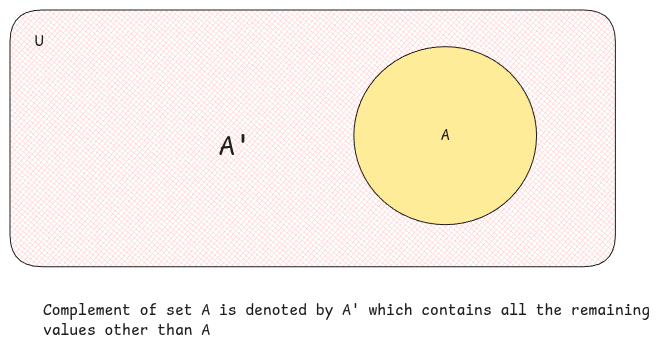
Complement is set theory concept where, the set contains a fixed set of values. Complement of A means, all values other than the A in the set is the complement of A.
The set has a fixed set of values. This is where the fixed width arithmetic comes into play. Mathematical complements are relative to the width.
1's and 9's complement
This is the actual complement. Here every digit is subtracted from the maximum possible digit in that base.
- subtract every digit with maximum possible digit.
- subtract entire value from the maximum possible value in that base.
Both produce the same thing. This is why 1's complement is also denoted using .
- In case of base 10 and width 3, maximum digit is 9. Therefore, 9's complement of 245 is 754.
- In case of base 2 and width 4, maximum digit is 1. Therefor, 1's complement of 1010 is 0101.
If you see in both cases, the sum of the number and its complement is always the maximum possible value in that base.
In case of binary, 1's complement is just toggling the bits. Hence, implementing this is easy in hardware.
Using complements to build negation
In case of arithmetic negation, we represent as as it's negated value. This then makes .
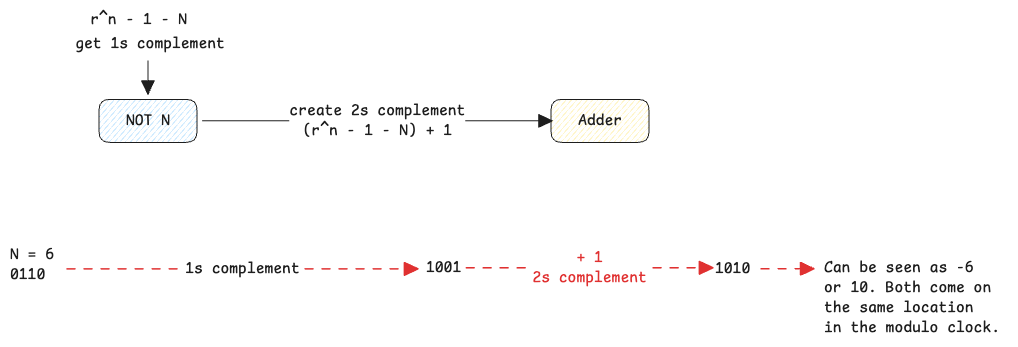
For this to happen, we need to add 1 to the complement of the number. This is exactly why we end up with 2's and 10's complement. 2's and 10's complement are just 1's and 9's complement + 1 respectively.
In arithmetic, complement and negation aren't the same. Number + complement of number = max value of the set. Number + negation of number = 0.
Complement of a number is the rest of the value available to reach the max possible value. Assume, base 10 and width 3. is . For value , the complement is because .
Negative Numbers in computers
Since sum of the number and its 2's complement results in 0, computers use this to represent negative numbers.
Whenever you come across this word, just consider that it's the concept used in computer hardware for representing negative numbers in a fixed with arithmetic.
As a consequence of this, .
IMPORTANT - Fixed with arithmetic is what computers need because the registers are of fixed width.
How's subtraction achieved using addition itself?
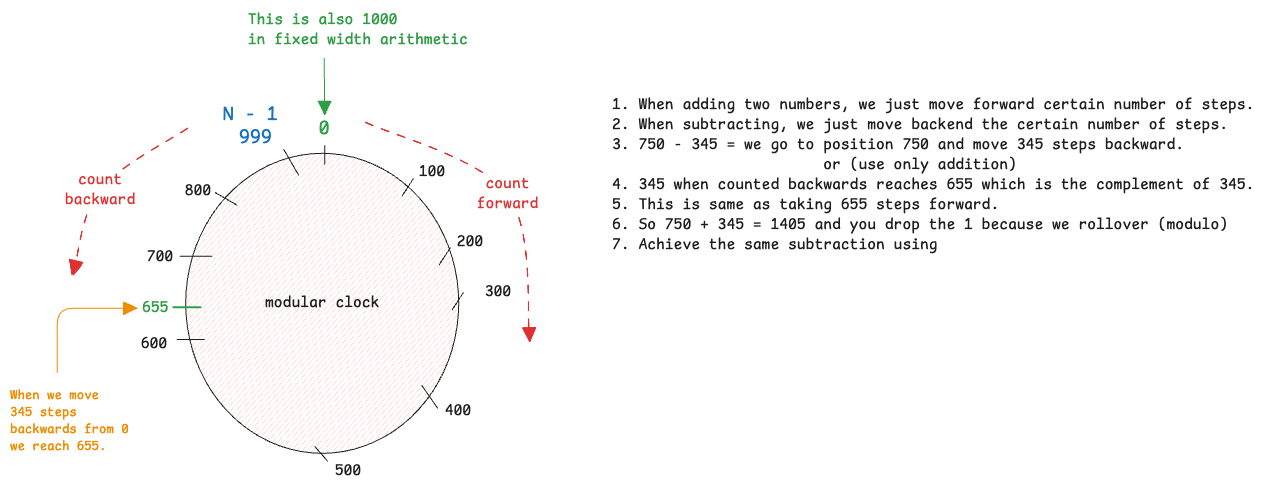
Subtraction in the above image is achieved using addition itself. To perform this addition we need the complement value. Generating complement is again a subtraction from the maximum value. This trick is what must be understood to see how this really works.
In case of binary, is the maximum value. is always just 1's. To subtract any binary from just 1's, we just have to toggle each bit. This is because when we already have all 1's, there is no need of carry or borrow or whatsoever.
Clocks to understand complements
In a fixed width arithmetic, we can use modulo to understand complements. We know that modulo can be explained using a clock analogy.
In case of , the clock has 1000 values from 0 to 999. For a value 655, the complement is 345 because . This also means, if we go 345 steps backward from 0, we reach 655.
- Moving clockwise is addition ().
- Moving counter-clockwise is subtraction ().