LLM Architecture
The page only tries to compile a high level understanding of the LLM architecture. Details will be added as and when new internal details are learnt.
Terminologies
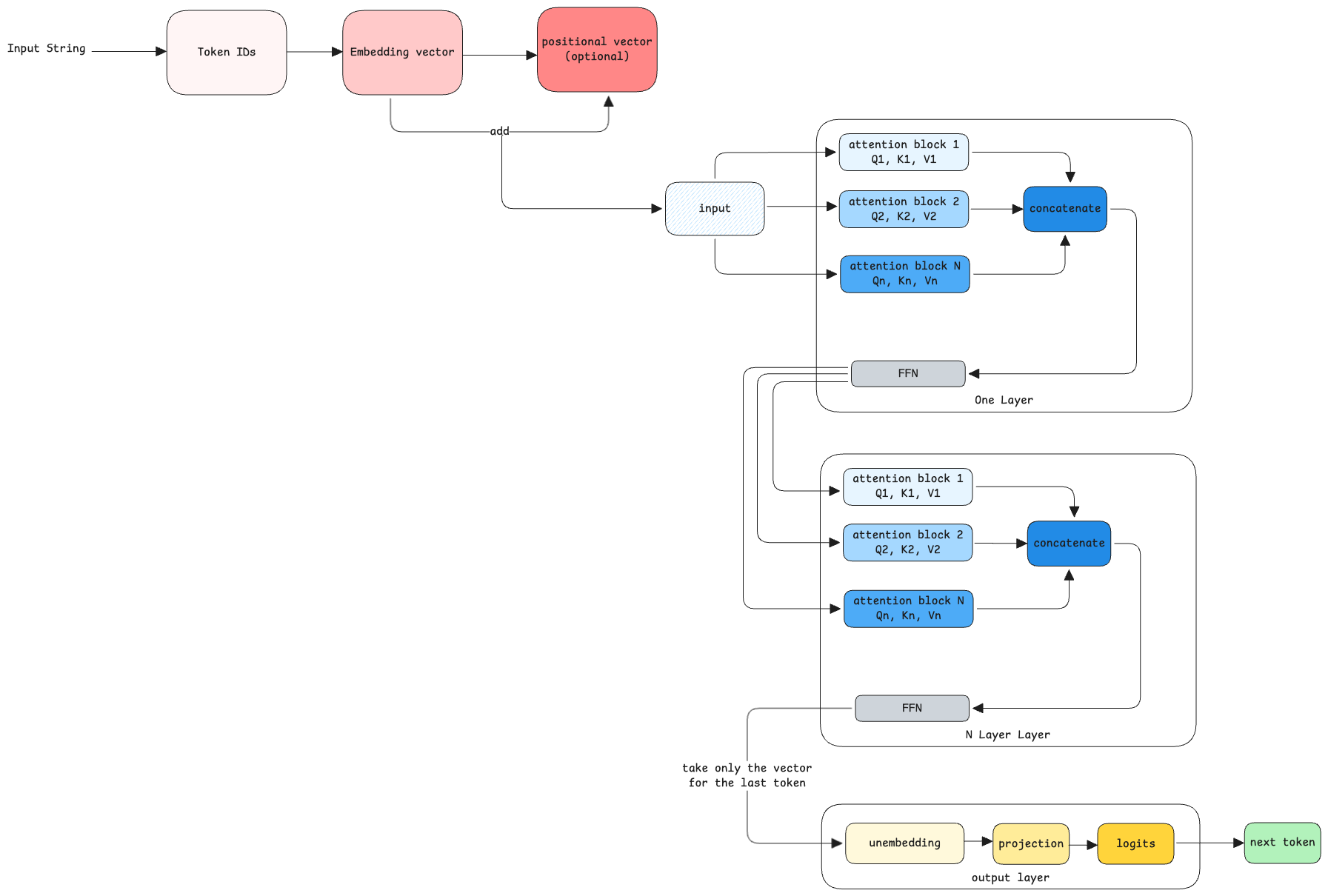
- Tokenization - gives every word in the sentence a value based on the model's dictionary. Since not all words are in the vocabulary, the words are split into small reusable parts and then the corresponding numeric ID is assigned.
- Embedding Vectors - Map each token ID to an embedding vector. The size of this vector is model dependent and model architects decide it before the training.
- Positional Vectors - Again another table where every position has a vector. Meaning, for a word at position 1, there is a fixed vector. This gives weightage based on the position of the word in the entire sentence/context.
- Positional and Embedding vectors are added and the final vector is feed into transformer layers.
- Now the vectors for all tokens are taken as a matrix. If we put 1-D arrays/vectors one below the other, it's becomes a matrix.
- Every transformer block/layer contains the following -
- Multi Head Layer
- Each layer has its own Q, K and V values.
- Each layer works on the same input vector.
- Each layer works on different aspects of the language.
- Output of each layer is then concatenated.
- Feed Forward Neural Network Layer
- Here more complex patterns and relationships are applied to the input vector.
- Multi Head Layer
- Output Layer
- The input matrix has now been updated by different layers and passed to the output layer.
- The output layer just uses the value of the last token in this matrix.
- This is then passed to an un-embedding layer to decide the next token.
- In this step, the matrix is multiplied with another predefined matrix to generate a final output matrix that will then be the size of the model's vocabulary.
It's about taking the final vector from the matrix and multiplying with another vector.
When we multiply with then we get matrix. Which means, we've a value for every word of the vocabulary.
Also, projection is a matrix concept of changing dimensions of the matrix.
This is the old method to use a table for positional vectors. This causes limitation because the table can't be too large where as the context in many models are already 1M length.
Hence most of the new models have positional vector calculation as part of the transformer layer.
Q, K and V in LLMs
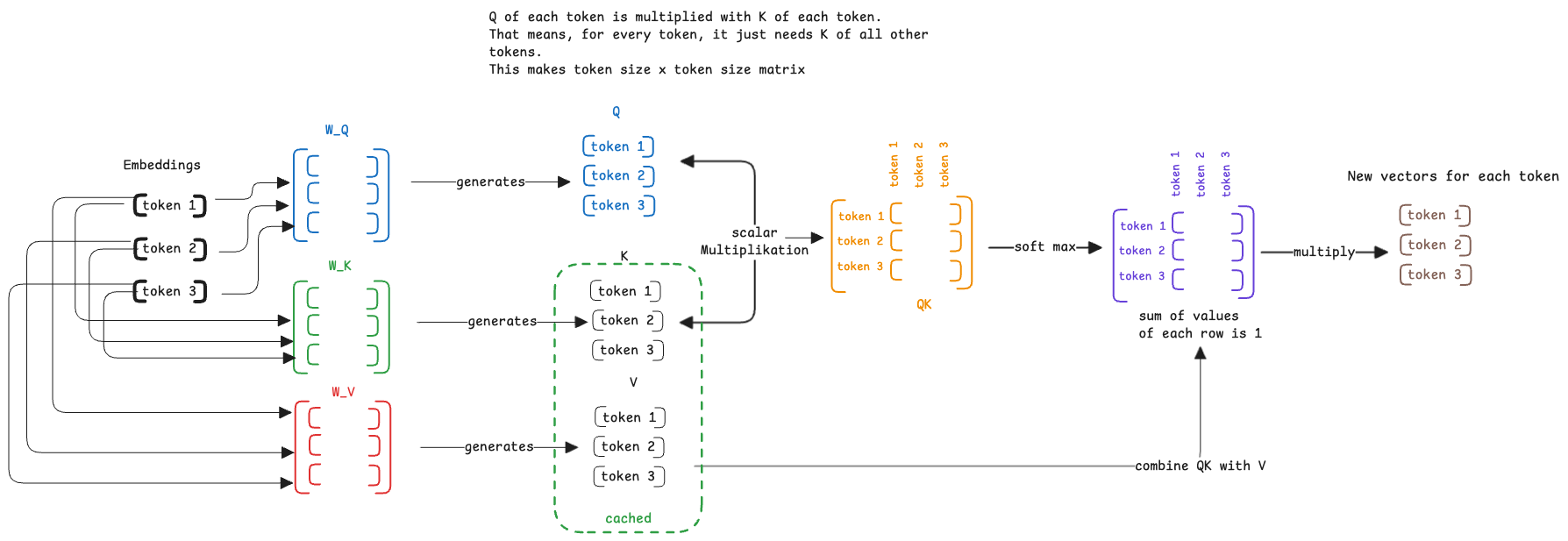
- During training, the W_K, W_Q and W_V are generated. They're the actual weights.
- Every token embedding vector is then multiplied by W_K, W_Q and W_V to generate the Q, K and V vectors.
- At this stage, Q, K and V vector values aren't dependent on other tokens.
We must keep in mind that Q, K and V are vectors for each token. Only when vectors for all tokens are considered together, then it's just all vectors put one below the other which makes it a 2-D matrix.
Size of weight matrices
Since the weight matrices are multiplied with the token vectors to generate Q, K, V vectors, the length of the token vector must be same as the number of rows of the weight matrix. This is necessary for the matrix multiplication to work.
Vector is always . The weight matrix then be .
This means, the output of matrix multiplication will result in a vector with length being the number of columns in the weight matrix. In most cases, this will reduce the size of the token embedding which makes the further calculations performant.
Attention between tokens
Initially, the LLM only calculates or figures out what value each token is bringing to the context. This is done by generating the Q, K and V vectors for the token.
- Query - What's the information that the token is looking for?
- Key - What does the token provide? Is it even important?
- Value - Information that the token provides, if the key is really important.
The relation between tokens only happens after that. Q and K from rest of the tokens are first combined and then the result is combined with V of the rest of the token.
Q and K are first multiplied to figure out for each token, what does it look for and which other tokens provides the information it's looking for.
V is then multiplied at the end after few other mathematical calculations are done.
- Prefill - This is about processing the input context. In this case, the vector of all tokens are simply put in as a matrix and K, V and Q values are generated in one go and then cached.
- Decode - This is about generating the next token. Here the K and V values from previous generated are used from cache.
K V Cache
KV cache is about caching the K and V generated values to avoid performing matrix multiplications during generation of next tokens.
To generate the next token, the transformer only uses K from all previous token to multiply with Q of the current token and at the end, it uses V from all tokens to get it's new embedding.