Hoisting
This is a JavaScript concept. The compiler moves variable and function declarations up. This is exactly why JS doesn't throw errors when you use 'var' variables before you declare them.
This is just like hoisting a flag up a pole. Here, the variables are pulled up in their scopes.
Hoisting depends on scope of the variable
During hoisting, each variable moves to the highest point its scope allows.
- var - these are hoisted to the function or the global scope, whichever is the parent. var has no real block scope, even though you can declare it inside a block.
- let - hoisted within its own scope level.
- const - hoisted within its own scope level.
Actual hoisting only for var
True hoisting happens only for the var keyword. For the rest, the lexical environments are just created as is.
This is also because var existed from day one of JavaScript. const and let came later.
function example() {
    const a = 1; // Function-scoped
    let b = 2; // Block-scoped to function body
    {
        const c = 3; // Function-scoped (ignores block). Will be moved to top of the function.
        let d = 4; // Block-scoped to inner block
        console.log(a, b, c, d); // 1, 2, 3, 4
    }
    console.log(a, b, c); // 1, 2, 3
    console.log(d); // ReferenceError: d is not defined. Error during execution.
}

example();
Default value assignment
Only var gets both a hoist and a default value. It moves to the top of its scope. And it's set to 'undefined'.
let and const are hoisted but get no value, not even undefined. Using one before its assignment throws an error at runtime.
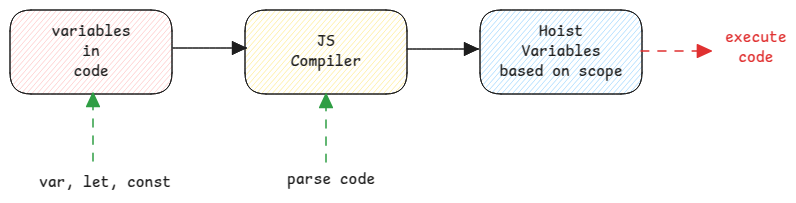
Hoisting is just the creation of the lexical environment. The compiler pulls each variable up to the lexical environment map it belongs to.
Block Scope
In JavaScript, block scope is any code inside curly brackets. But not functions.
if, for and while loops, closures, etc.
Functions
All functions are also hoisted and added to the corresponding lexical environment.
If you assign a function to a 'const' variable, hoisting follows the const rules. You can't call the function until the variable points to the function definition.